
High Voltage Static Var Generator (High Voltage SVG)
High-speed dynamic reactive power compensation, voltage stabilization, and comprehensive harmonic mitigation engineered for 6kV, 10kV, and 35kV power systems.
Featuring a direct transformerless cascaded H-bridge architecture, iKonMac HV SVG systems deliver smooth, bidirectional power factor regulation from inductive to capacitive within 5ms—eliminating utility penalties, suppressing flicker, and reinforcing grid code compliance.
Drawing on 30 years of advanced power electronics manufacturing, iKonMac delivers fully integrated, factory-tested medium- and high-voltage SVG systems engineered for utility substations, renewables, and heavy industrial plants globally.
Core Electrical Metrics and Performance Benchmarks
Verified electrical baselines and performance thresholds designed for EPC contractors, electrical consultants, and grid integration engineers evaluating high-voltage static var generators and plant-wide harmonic mitigation systems.
Direct Medium-Voltage Coupling
Transformerless direct connection across 6kV, 10kV, 27.5kV, and 35kV utility networks with ±10% continuous dynamic voltage tolerance.
Full Dynamic Response
Transient reactive step control executes in under 1ms, delivering sub-cycle voltage stabilization and eliminating flicker from impact loads.
Continuous Bidirectional Span
Modular multi-unit parallel scaling from ±1 Mvar to ±100 Mvar with fiber-optic synchronized DC bus control and N+1 power cell redundancy.
Full Rated Load Metric
Carrier phase-shifted modulation optimizes IGBT switching profiles, reducing operational thermal losses well below conventional static var compensator (SVC) plants.
Tested and Certified for Heavy Industrial & Utility Interconnections
iKonMac delivers over 3.5 million kVA/kvar of power quality capacity annually. Every high-voltage static var generator undergoes complete full-voltage dielectric withstand, impulse insulation, and full-load temperature-rise factory acceptance tests prior to shipment.
Full-Voltage Dielectric Testing
100% factory BIL and Hi-Pot validation
Continuous Thermal Heat-Run
Calibrated full-load dynamic test cell runs
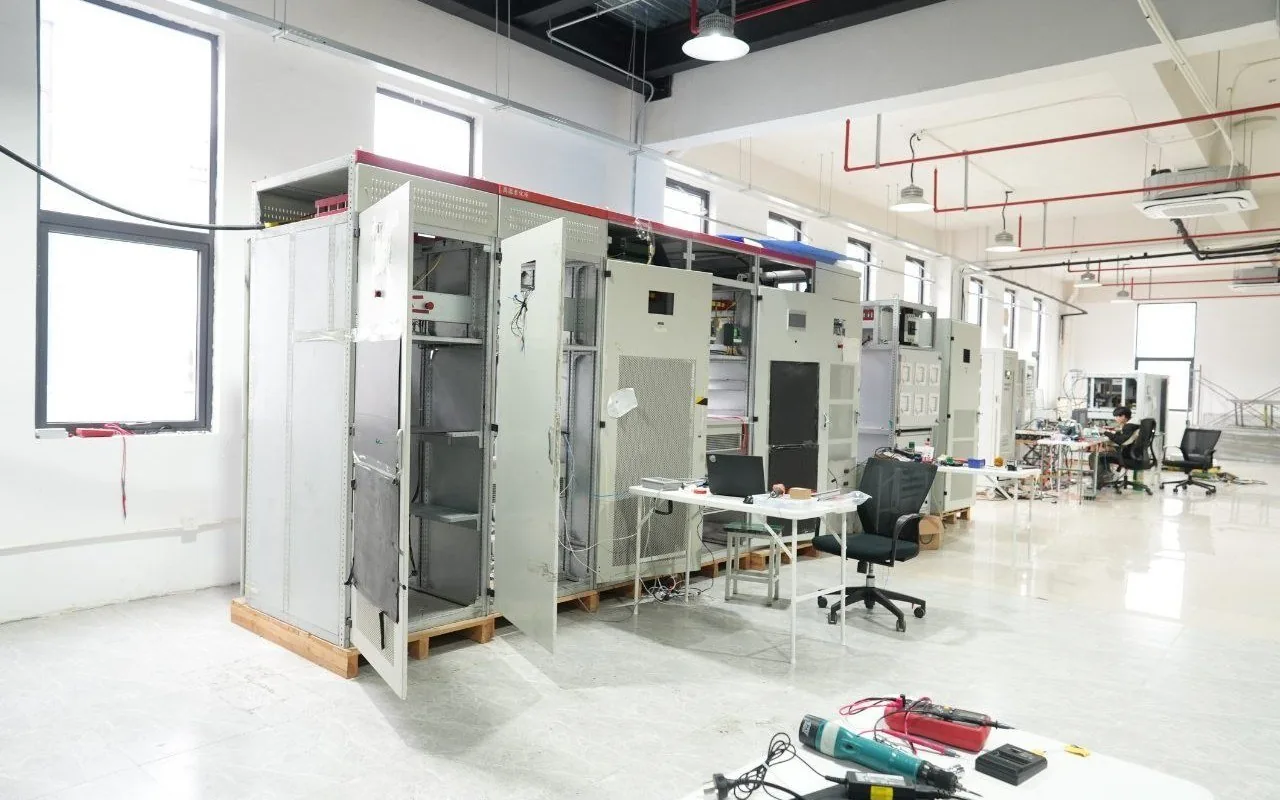
High Voltage SVG
Browse all High Voltage SVG products - utility-grade cascaded H-bridge systems for direct 6-35 kV bus connection, substation voltage support, and heavy industrial reactive power control.
Try removing one or more filters.
Cascaded Multilevel Topology and Power Cell Self-Healing Bypass
Direct medium-voltage interconnection without an intermediate step-up transformer demands advanced voltage waveform synthesis, minimal harmonic distortion, and autonomous fault mitigation. The iKonMac High Voltage Static Var Generator (HV SVG) employs a transformerless cascaded H-bridge (CHB) multilevel converter topology to deliver sub-cycle, bidirectionally controlled reactive power compensation across 6kV, 10kV, and 35kV utility and industrial distribution systems. By configuring standardized single-phase power cells in series along each phase leg, the inverter synthesizes a high-resolution stepped PWM voltage that closely mirrors a pure sinusoidal waveform.
Developed by our dedicated engineering team of more than 50 power electronics specialists holding dozens of patents in digital control architectures and multilevel topologies, this chain-circuit design integrates carrier phase-shifted modulation with solid-state thyristor bypass protection. When an individual IGBT cell detects an over-temperature, driver desaturation, or over-voltage event, the hardware isolates the compromised cell in less than 1.5 milliseconds, preventing unscheduled substation trips and preserving symmetrical three-phase voltage stability.
Transformerless Cascaded H-Bridge
Connects directly to medium-voltage utility buses by stringing identical single-phase H-bridge converter cells in series per phase leg, eliminating bulky step-up transformers and core losses.
- • Pure Waveform Synthesis: Multi-step staircase output closely tracks pure sinusoidal profiles, suppressing low-order harmonics without requiring a supplementary active harmonic filter or large external filter networks.
- • Controlled dv/dt Stress: Incremental voltage steps remain below 700V per switching event, safeguarding motor and transformer windings against insulation aging.
- • Superior System Efficiency: Removing the intermediate coupling transformer elevates full-load operating efficiency beyond 99.2% under rated capacitive and inductive duty.
Sub-1.5ms Dynamic Power Cell Bypass
Couples high-speed bidirectional thyristor switches with parallel mechanical contactors to isolate degraded power cells instantly without interrupting plant operations.
- • Solid-State Shunt: Antiparallel thyristors trigger within 1.5ms of driver desaturation, DC over-voltage, or thermal alarms, maintaining continuous series current flow.
- • Mechanical Latch: A heavy-duty mechanical contactor closes within 15ms to carry continuous phase current, relieving thermal dissipation on the solid-state bypass.
- • N+1 / N+2 Redundancy: Integrated reserve cells sustain full rated dynamic capacity or transition automatically into balanced, down-rated compensation.
Carrier Phase-Shifted PWM & Balancing
Distributes switching cycles across series-connected H-bridge modules using carrier phase-shifting, multiplying effective carrier frequency while minimizing individual IGBT switching losses.
- • High Equivalent Frequency: Individual cells switch at low fundamental frequencies, while the synthesized grid output frequency reaches tens of kilohertz.
- • DC-Bus Voltage Auto-Balancing: Microsecond digital control algorithms modulate active power vectors, keeping DC capacitor voltage divergence under 1%.
- • Neutral-Point Dynamic Rebalance: Proprietary zero-sequence vector offset algorithms adjust star-point potential during bypass events to maintain balanced line voltages.
Modular H-Bridge Cell Chain & Real-Time Fault Bypass Logic
Operational Mode Simulation
Select an operational condition below to evaluate how high-speed solid-state bypass hardware and digital control loops safeguard medium-voltage power continuity in real time.
Phase Leg Real-Time Schematic
Normal Operation: 100% Voltage DeliveryStandard operation: All H-bridge series modules synthesize smooth staircase voltage waveforms using carrier phase-shifted PWM with zero harmonic distortion.
Engineering Specification Matrix: Multilevel Chain Topology
Standardized cell counts and electrical parameters across standard medium-voltage utility distribution ratings.
| Nominal Grid Rating | Series Cells / Phase | Synthesized Levels | Bypass Redundancy | Maximum dv/dt | System Efficiency |
|---|---|---|---|---|---|
| 6 kV Line-to-Line | 5 to 6 Cells | 11 to 13 Levels | N+1 Autonomous | < 500 V / µs | ≥ 99.2% |
| 10 kV Line-to-Line | 8 to 9 Cells | 17 to 19 Levels | N+1 Standard (N+2 Option) | < 550 V / µs | ≥ 99.3% |
| 27.5 kV Traction | 15 to 17 Cells | 31 to 35 Levels | N+2 High-Availability | < 650 V / µs | ≥ 99.1% |
| 35 kV Line-to-Line | 21 to 24 Cells | 43 to 49 Levels | N+2 Standard | < 700 V / µs | ≥ 99.0% |
Verify Topology Redundancy with Project-Specific DIgSILENT Modeling
Consult directly with senior application engineers at iKonMac to calculate cell series sizing, evaluate fault-clearing reserve margins, and receive detailed single-line schematics for 6kV, 10kV, and 35kV substations.
High Voltage SVG Mechanical Configurations — Indoor Cabinet, Outdoor Containerized SVG, and Open-Frame Systems
Integrating a High Voltage Static Var Generator (High Voltage SVG) into medium-voltage utility substations, renewable energy collector systems, or heavy industrial facilities for mission-critical reactive power compensation requires uncompromising synergy between advanced power electronics packaging and civil site conditions. Long-term operating stability depends on shielding sensitive fiber-optic gate drivers, DC-link film capacitors, and cascaded multi-level IGBT power cells from harsh industrial pollutants while preserving low thermal resistance across all operating phases. iKonMac engineers three standardized mechanical architectures built to satisfy global utility standards for structural rigidity, seismic withstand, environmental sealing, and thermal dissipation across 6kV, 10kV, and 35kV networks.
From space-constrained indoor switchgear rooms and coastal ports exposed to marine salt spray, to high-altitude mines and arid desert solar plants experiencing extreme diurnal cycling, iKonMac medium-voltage SVG enclosures maintain stable thermal equilibrium and safe electrical clearances. Operating across more than 50 countries in ambient operating envelopes from -40°C to +50°C, these validated structural layouts eliminate complex field modifications and accelerate site civil commissioning.
Indoor Standard Cabinet Line
Engineered for modern indoor electrical switchrooms, industrial substation basements, and commercial distribution facilities requiring rapid power factor correction. This indoor SVG cabinet configuration features a compact vertical footprint optimized for seamless lineup integration alongside standard medium-voltage switchgear.
Thermal Management
Positive-pressure forced-air convection with redundant high-static brushless blower assemblies or low-noise phase-change heat-pipe exchangers.
Structural Footprint
Compact depth profiles from 800 mm to 1,000 mm with standardized drawout power cell cassettes and full front-access service doors.
Ingress & Containment
Internal segregated arc-containment barriers, washable synthetic particulate filters, and gravity-driven automatic backdraft dampers.
Typical Applications
Automotive stamping plants, hyper-scale data centers, indoor municipal pump stations, and chemical processing switchgear corridors.
Integrated Outdoor Containerized SVG
Self-contained outdoor containerized SVG packaged in standardized ISO 20-foot or 40-foot Corten steel walk-in enclosures. Delivered fully integrated, wired, and factory-tested for immediate placement on concrete plinths or steel piers without constructing dedicated buildings.
Climate Control Architecture
Dual-redundant industrial inverter HVAC modules with active dehumidification loops, thermal staging, and low-temperature preheating coils.
Environmental Hardening
Certified IP54 SVG container construction with C5-M high-durability marine protective coatings, sand-separation louvers, and dual-gasket seals.
Safety & Fire Suppression
Autonomous fire monitoring hub with multi-criteria optical smoke and heat detectors, motorized HVAC shutoff dampers, and clean-agent aerosol suppression.
Typical Applications
Wind and solar collector substations, offshore terminal feeder yards, desert microgrids, battery storage interconnects, and pipeline pumps.
Open Frame & Modular E-House Architecture
Tailored for large-scale 27.5kV and 35kV transmission substations, heavy metallurgical sites, and high-Mvar compensation nodes requiring active harmonic mitigation. Utilizes a modular frame SVG configuration or custom prefabricated walk-in electrical house (E-House) with dedicated maintenance corridors for high-voltage valve stacks.
Inspection & Clearance
Generous internal inspection corridors that satisfy IEEE and IEC phase-to-ground isolation clearances for simplified preventive inspections.
HV Valve Rack Modularity
Hot-dip galvanized structural steel valve framing designed for scalable cascaded H-bridge stacks, post insulators, and outdoor air-core reactors.
Ventilation & Separation
Physically partitioned power valve chambers and digital control compartments with dedicated positive-pressure air handling zones.
Typical Applications
Bulk 35kV utility grid interconnects, 27.5kV railway traction substations, electric arc furnace (EAF) busbars, and deep underground mine hoists.
Engineering Specification Matrix Across Mechanical Enclosures
Review critical mechanical boundaries, structural materials, environmental thresholds, and civil site requirements to select the optimal configuration for your facility.
| Technical Parameter | Indoor Standard Cabinet Line | Integrated Outdoor Containerized SVG | Open Frame / E-House Architecture |
|---|---|---|---|
| Ingress Protection Rating | IP30 standard, IP42 with louvered particulate mesh | IP54 hermetically sealed, weather-tight | IP00 (open rack valve hall) or IP43/IP54 (walk-in E-House) |
| Structural Metallurgy | 2.0 mm to 2.5 mm Aluzinc and powder-coated cold-rolled steel | Corten high-tensile structural steel with thermal rock-wool insulation | Hot-dip galvanized structural carbon steel (ASTM A123 compliant) |
| Ambient Operating Temperature | -10°C to +40°C (conditioned building) | -40°C to +55°C (active dual inverter HVAC systems) | -25°C to +45°C (conditioned building or ventilated hall) |
| Cooling System Architecture | Positive-pressure high-velocity fan trays with speed regulation | Dual redundant industrial inverter HVAC with dehumidification | Ducted forced-draft air handling or natural convective airflow |
| Seismic Qualification | IBC Seismic Zone 3 / IEEE 693 Moderate performance class | IBC Seismic Zone 4 / IEEE 693 High Withstand certification | Project-engineered structural anchoring per IEEE 693 criteria |
| Fire Safety Integration | Substation SCADA dry-contact alarm output and remote trip trip-link | Autonomous aerosol or FM-200 clean agent with motorized dampers | Multi-zone aspiration smoke detection and deluge integration |
| Civil Installation Scope | Indoor reinforced slab with sunken cable trenches or raised floors | Precast strip footings, concrete slab, or structural steel piers | Engineered foundation slab with transformer and reactor pads |
| Typical Capacity Range | ±1 Mvar to ±10 Mvar per unified cabinet lineup | ±2 Mvar to ±35 Mvar per individual ISO container | ±20 Mvar to ±100+ Mvar scalable multi-stack configurations |
Thermal Fluid Dynamics and Internal Airflow Optimization
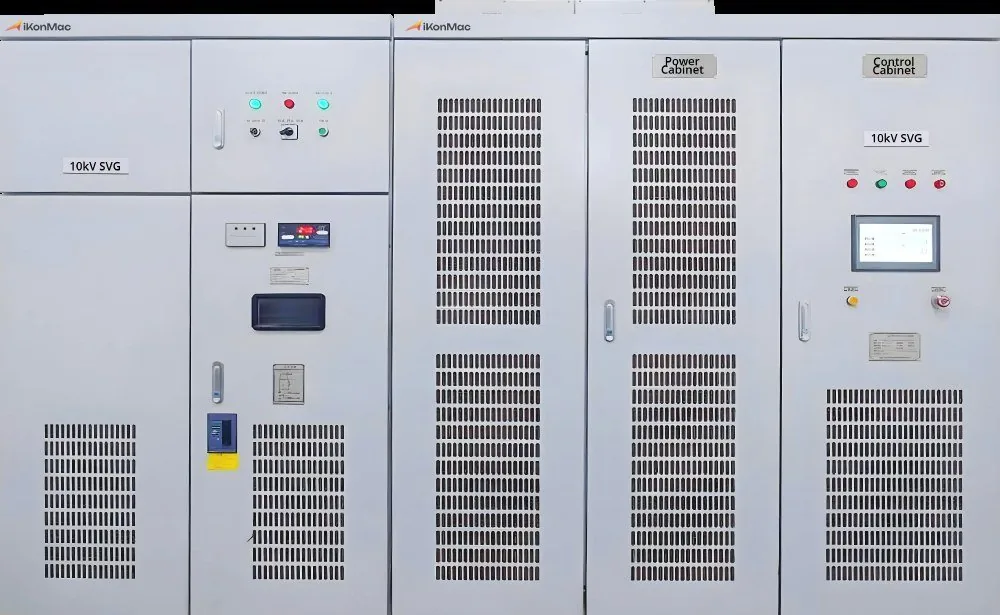
The continuous operating lifetime of IGBT modules in a cascaded multilevel High Voltage SVG is directly determined by junction temperature stability during dynamic var injection. iKonMac engineers employ advanced Computational Fluid Dynamics (CFD) modeling to establish dedicated, non-turbulent thermal pathways through every enclosure type. In both indoor cabinet banks and containerized platforms, cold intake air streams are isolated from hot discharge zones by mechanical air baffles, eliminating internal thermal recirculation.
In our outdoor containerized SVG, positive-pressure air distribution produces a uniform laminar airflow across the heat sinks of every series-connected H-bridge power cell. Even during sustained 50°C desert ambient conditions with maximum capacitive output, power module temperatures stay well beneath critical semiconductor junction limits, maintaining a thermal gradient of ΔT < 25°C above ambient intake air.
- ✓ Isolated Airflow Ducts: Prevents conductive airborne dust, moisture, and industrial particulates from bridging medium-voltage insulation clearances.
- ✓ Dynamic Fan Speed Regulation: Modulates blower speeds according to real-time junction temperature feedback to reduce auxiliary auxiliary station power losses.
- ✓ Cold-Start Thermal Preheating: Automatically prevents medium-voltage energization during sub-zero cold starts until power cell capacitors and IGBTs reach safe operating temperatures.
Environmental Hardening for Extreme Utility and Industrial Deployments
High-Salinity Coastal Resistance
For coastal renewable collector yards, offshore substations, and marine ports, container skins receive multi-coat zinc-rich primers and aliphatic polyurethane finishes rated to ISO 12944 C5-M extreme marine durability, paired with 316-grade stainless steel exterior hardware.
Desert Sandstorm Defense
Enclosures destined for arid desert regions feature multi-stage inertial sand-separation louvers and G4 pre-filtration stages. Airborne particulate matter down to 5 microns is removed prior to reaching HVAC coils, preventing abrasive wear on cooling fans and post insulators.
Seismic and Wind Load Ratings
Engineered with reinforced structural corner blocks and full-penetration seam welding, iKonMac enclosures resist Category 5 hurricane wind velocities up to 160 mph (260 km/h) and exceed IEEE 693 high-level seismic ground acceleration criteria.
Need Detailed Civil Foundation Drawings for Your Substation?
Our substation civil engineering group provides complete AutoCAD and Revit 3D BIM models, dynamic load point tables, cable trench clearance requirements, and thermal exhaust specifications tailored to your site coordinates.
Technical Comparison — High Voltage SVG vs. Conventional SVC and Capacitor Banks
Modern medium-voltage distribution systems and heavy industrial networks face rapid reactive power swings, severe voltage flicker, and stringent interconnection grid codes. Legacy compensation systems—including traditional static var compensator (SVC) units, Thyristor-Controlled Reactors (TCR), Magnetically Controlled Reactors (MCR), and Mechanically Switched Capacitor Banks (MSCB)—rely on variable impedance principles. Because their reactive output is tied directly to system voltage, their stabilizing capacity collapses precisely when the utility grid needs it most during deep voltage depressions.
In contrast, an advanced High Voltage Static Var Generator (High Voltage SVG / STATCOM) operates as a dynamic, self-commutated voltage source converter. Built upon a modular cascaded H-bridge (CHB) multilevel topology, the High Voltage SVG supplies continuous, bi-directional reactive power from -1.0 inductive to +1.0 capacitive in under 5 milliseconds. This active design eliminates harmonic resonance risks, reduces substation switchyard footprint by up to 70%, and provides guaranteed current-source injection during critical grid faults.
| Engineering Metric | High Voltage SVG (STATCOM) | Conventional SVC (TCR / MCR) | Mechanically Switched Capacitors |
|---|---|---|---|
| Dynamic Response Time | ≤ 5 ms full dynamic response (≤ 1 ms step output initiation) | 20 ms to 40 ms (dependent on thyristor firing phase) | Several seconds to minutes (switching & discharge delays) |
| Voltage Sag Output Characteristic | Constant current source: Delivers 100% rated current down to 20% residual bus voltage | Variable impedance source: Reactive output degrades quadratically with voltage (Q ∝ V²) | Fixed impedance source: Reactive output plummets sharply during sags (Q ∝ V²) |
| Harmonic Generation & Filtering | Negligible intrinsic harmonics; actively mitigates up to 13th harmonic orders dynamically | Generates substantial 5th, 7th, and 11th harmonics; requires large passive filter (FC) branches | Generates no harmonics, but frequently triggers destructive parallel resonance with grid impedance |
| Substation Real Estate & Footprint | Ultra-compact: 50% to 70% footprint reduction via high-density cascaded IGBT power cells | Extensive yard space required for air-core reactors, damping circuits, and capacitor banks | Large physical footprint required for multiple circuit breakers, disconnectors, and capacitor racks |
| Low-Voltage Ride-Through (LVRT) | Full grid code compliance; supplies instant reactive current boost during symmetrical and asymmetrical faults | Compromised support capacity under severe faults; struggles with demanding renewable interconnect codes | Zero dynamic ride-through capability; typically trips offline via undervoltage protections |
| System Operating Efficiency | ≥ 99.2% full-load efficiency; low standby and operational losses across the full operating range | Higher continuous heat dissipation in high-power reactors and auxiliary cooling systems | Low nominal electrical loss, but high ongoing maintenance costs due to contactor wear and damping inrush |
Controlled Current Source Physics
Traditional TCR systems function as passive variable reactances governed by the square of bus voltage ($Q propto V^2$). When grid disturbances drive voltage down, conventional SVC output plummets. An iKonMac High Voltage SVG operates as a self-commutated voltage source converter behind a coupling reactance, maintaining 100% rated dynamic reactive current down to 20% residual bus voltage to prevent systemic voltage collapse.
Active Harmonics & Zero Resonance
Using carrier phase-shifted pulse-width modulation (CPS-PWM), our multilevel architecture synthesizes an ultra-smooth stepped voltage wave with total harmonic distortion below 2.5%. Unlike TCRs that inject heavy 5th and 7th harmonic currents requiring vast passive filter yards, our High Voltage SVG dynamically cancels grid harmonics up to the 13th order without risk of parallel resonance with grid impedance.
Substation Land & Civil Optimization
Eliminating massive air-core reactors, safety clearances, magnetic exclusion zones, and open capacitor racks cuts civil land footprint by 50% to 70% compared to equivalent TCR/MCR installations. Systems can be housed in indoor standard switchgear cubicles or fully integrated weatherproof ISO containers, radically simplifying civil engineering and environmental permitting.
Substation Retrofitting: Modernizing Legacy SVC and Capacitor Installations
Aging industrial distribution facilities and utility interconnects frequently struggle with outmoded TCR and fixed capacitor installations that suffer from thyristor valve degradation, oil leakages, obsolete spare parts, and response times too sluggish for modern grid codes. Since 1994, iKonMac has engineered turnkey brownfield retrofits worldwide, replacing legacy static var systems with high-efficiency, multilevel High Voltage SVG architectures.
- ✓ Direct replacement inside existing switchyard boundaries without purchasing adjacent real estate
- ✓ Complete elimination of catastrophic harmonic trapping and LC network resonance risks
- ✓ Instant compliance with IEEE 519, IEC 61000-4-30, and modern LVRT/HVRT utility mandates
- ✓ Full-cycle engineering support from DigSILENT network modeling through full-voltage FAT testing
Harsh Operating Environments and Heavy Industrial Applications
Demanding medium-voltage utility networks and industrial distribution grids face rapid reactive load fluctuations, severe voltage flicker, and harmonic pollution requiring advanced harmonic mitigation. The iKonMac High Voltage SVG provides instantaneous, continuous bi-directional reactive compensation across 6kV, 10kV, 27.5kV, and 35kV power systems with sub-5-millisecond dynamic response. More than 3,000 industrial plants, EPC contractors, and electrical grid operators rely on iKonMac systems to maintain stringent grid code compliance, safeguard mission-critical transformers and drives, and eliminate costly utility penalty charges.
Utility-Scale Wind and Solar Grid-Tie Integration
Modern utility interconnection standards enforce stringent power factor and voltage support at the Point of Common Coupling (PCC). Intermittent generation and extensive underground medium-voltage cable collector systems produce nocturnal Ferranti-effect overvoltages as well as sudden voltage drops during daytime generation ramps. iKonMac High Voltage SVG systems provide continuous, sub-cycle capacitive and inductive reactive power control to stabilize collector bus voltage and maintain unity power factor under fluctuating resource conditions.
LVRT and HVRT Support
Injects 100% rated dynamic reactive current during severe voltage dips down to 0% residual voltage within 1.5ms, maintaining seamless grid-tie synchronization and avoiding inverter disconnections.
Cable Capacitance Neutralization
Provides continuous inductive var absorption during light-load or zero-generation periods, neutralizing cable charging capacitance and preventing high-voltage feeder trip-outs.
- Grid Code Compliance: Fully satisfies IEEE 1547, IEEE 2800, and regional transmission operator (RTO/TSO) dynamic reactive bandwidth standards.
- Containerized Deployment: Standard IP54 weatherproof outdoor containers engineered for severe desert solar farms, high-altitude UV radiation, and sub-zero wind sites.
Dual-Core Digital Control, Fiber-Optic Isolation & Substation Protection Architecture
Critical utility substations and heavy industrial plants operating at 6kV, 10kV, and 35kV require absolute control determinism and comprehensive electrical immunity. Delivering superior performance compared to a conventional static var compensator, the iKonMac High Voltage Static Var Generator integrates an ultra-fast dual-core digital processing engine, total multi-mode optical fiber galvanic isolation, and a seven-tier hardware-firmware protection matrix. This purpose-built architecture computes real-time dynamic reactive compensation commands within microseconds while keeping digital logic entirely isolated from severe grid switching surges and electromagnetic transients.
Dual-DSP + FPGA Processing Engine for Instantaneous Vector Computing
The core digital controller utilizes dual 32-bit floating-point Digital Signal Processors (DSP) synchronized with a high-density Field-Programmable Gate Array (FPGA). This decoupled multi-processor topology separates high-speed analog acquisition from advanced p-q and d-q coordinate frame transformations.
- Sub-Cycle Calculation Latency: Multi-channel parallel ADCs sample grid voltages and line currents simultaneously, updating compensation current references in under 15 μs.
- Carrier Phase-Shifted PWM Modulation: Real-time carrier phase-shifting optimizes equivalent switching frequencies to kilohertz levels while minimizing individual IGBT switching losses.
- Hardware-Level Fault Arbitration: The dedicated FPGA processes critical interlocks and overcurrent thresholds via pure logic gates, executing emergency shutdowns in ≤1.5 μs.
Complete Galvanic Isolation via Multi-Mode Industrial Optical Fiber
Direct high-voltage grid connection demands impenetrable physical and electrical separation between the ground-referenced digital control cubicle and floating H-bridge power cells. Industrial-grade optical fiber links eliminate conductive paths, ground loops, and potential flashover risks.
- Bidirectional High-Speed Optical Channels: Transmits PWM firing pulses to cell drivers while feeding back real-time DC-link voltages, IGBT junction thermal statuses, and cell diagnostics.
- EMC Level 4 Industrial Immunity: Engineered to satisfy stringent IEC 61000-4 standards, withstanding 4kV fast electrical transients (EFT) and high dv/dt common-mode surges.
- Zero Conductive Coupling: Total absence of copper control wiring between high-voltage chain links and human-accessible panels supports operator and maintenance safety.
Substation SCADA Interoperability & Protocol Integration
iKonMac high-voltage SVG control systems interface directly with utility telemetry, centralized Distributed Control Systems (DCS), and automated substation supervisory networks without requiring external protocol translation hardware.
Seven-Tier Coordinated Fast-Acting Electrical Protection Matrix
Protection is segregated into microsecond hardware clamps and deterministic firmware routines. This multi-layered architecture mitigates catastrophic semiconductor failure while preventing unwarranted complete system trips during minor grid transients.
System Control and Optical Routing Architecture
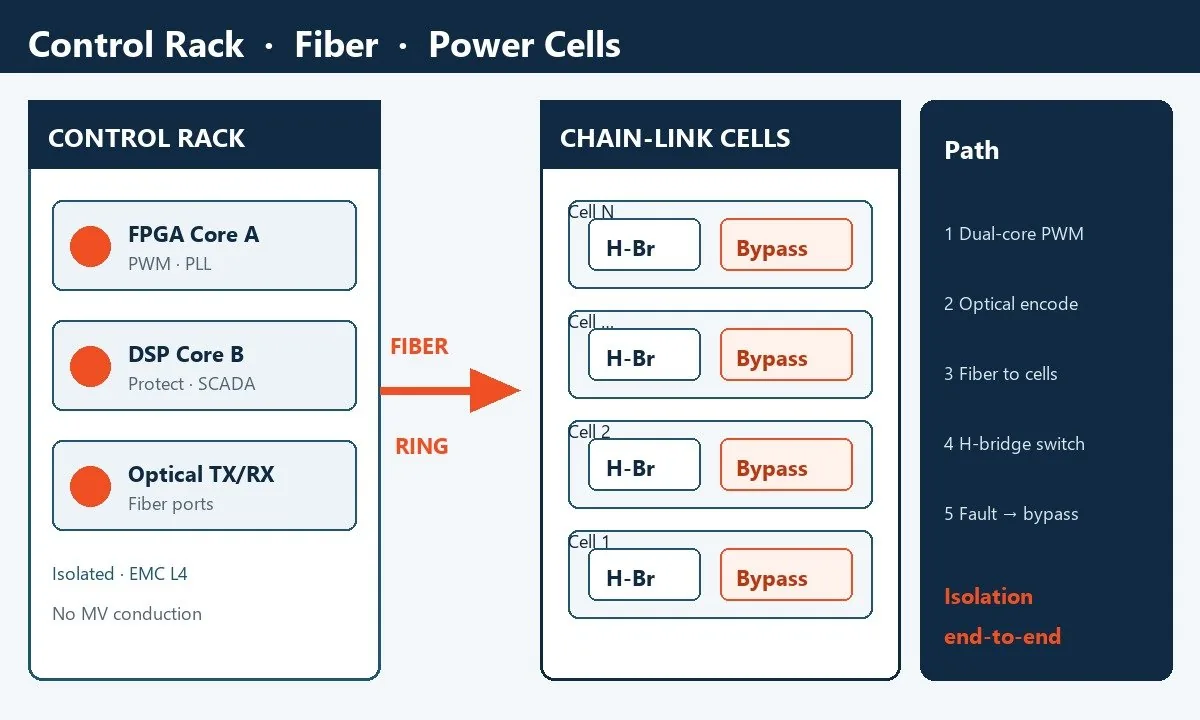
Physical layout schematic depicting isolated primary control rack, multi-strand fiber channels, and cascaded chain-link power cells with thyristor bypass contacts.
Control and Protection Engineering Benchmark Parameters
| Subsystem Domain | Technical Metric | Response Velocity | Implementation Standard |
|---|---|---|---|
| Digital Processor | Dual 32-bit DSP + Xilinx FPGA Matrix | ≤ 15 microseconds | Instantaneous p-q dynamic vector calculation |
| Optical Isolation | Multi-mode duplex industrial optical fiber | ≤ 20 nanoseconds | IEC 61000-4-2/4/5 Level 4 immunity |
| IGBT Desaturation | Hardware Vce collector voltage sensing | ≤ 1.5 microseconds | Driver-level automatic soft turn-off clamp |
| Hardware Cell Bypass | Solid-state thyristor + mechanical contactor | ≤ 1.5 milliseconds | N+1 / N+2 uninterrupted operation continuity |
| Substation Telemetry | Dual redundant 100Mbps Ethernet channels | ≤ 2 milliseconds | IEC 61850 MMS and GOOSE standard profiles |
Engineered for Severe Industrial and Substation Electromagnetic Environments
Backed by 30 years of specialized power electronics manufacturing and an in-house team of over 50 power quality specialists, iKonMac supports verified electrical safety and stable grid-interconnection compliance across all industrial products. Every high-voltage SVG controller undergoes exhaustive full-load simulation and hardware-in-the-loop validation prior to deployment.
iKonMac Power Quality Products and System Integration
iKonMac designs and builds coordinated compensation solutions spanning low-voltage branch circuits to 35kV utility substations. Seamlessly integrate industrial active harmonic filter systems, dynamic static var compensator modules, and advanced silicon carbide power electronics to safeguard your distribution network against power factor penalties, resonance, and harmonic distortion.
Active Harmonic Filter
Dynamic harmonic mitigation from the 2nd through 50th order, eliminating line distortion in commercial and industrial motor drive applications.
Static Var Compensator
High-speed stepless power factor correction and load balancing for fast-cycling industrial equipment and automated distribution boards.
Ultra Active Harmonic Filter
Ultra-compact active harmonic filtering designed for semiconductor cleanrooms, data centers, and mission-critical power architectures.
Silicon Carbide Converters
Wide-bandgap power conversion platforms delivering elevated switching frequencies, reduced thermal dissipation, and minimized cabinet volume.
End-to-End Grid Reliability from Branch Feeder to Substation Bus
Coordinate decentralized low-voltage active harmonic filters with centralized high-voltage SVG systems across 6kV, 10kV, and 35kV utility feeds. iKonMac provides full-lifecycle engineering, single-line modeling, and cross-platform SCADA diagnostics to support total grid code compliance.
Full-Lifecycle Engineering Delivery, Factory Simulation & Site Commissioning
iKonMac delivers turnkey power quality engineering—integrating advanced active harmonic filter systems—from initial network simulation and high-voltage factory testing through utility grid interconnection.
On-Site Audit & Power System Modeling
Baseline harmonic measurements and digital twin simulations characterize grid impedance and finalize optimal static var compensator Mvar sizing.
Key Milestones
- Grid impedance data collection
- Harmonic distortion profile analysis
- DIgSILENT & MATLAB digital twins
- Optimal Mvar capacity validation
Full-Voltage Factory Acceptance Testing
Full-load heat runs and transient-stress qualifications inside dedicated high-voltage test bays help reduce defect risk before shipment.
Key Milestones
- Rated system voltage load tests
- Dynamic thermal-rise verification
- Switching transient stress audits
- Customer-witnessed test certificates
Modular Site Installation & Hi-Pot Testing
Modular power blocks and busbar interconnects streamline mechanical erection before high-potential dielectric validation.
Key Milestones
- Modular cabinet interconnect assembly
- Low-loss main busbar alignment
- High-potential dielectric testing
- Auxiliary control wiring verification
Utility Joint-Commissioning & Handover
Coordinated grid energization, SCADA telemetry calibration, and operator instruction culminate in final operational sign-off.
Key Milestones
- Grid-synchronization validation
- SCADA telemetry channel calibration
- Operator and safety instruction
- Utility compliance certificate release
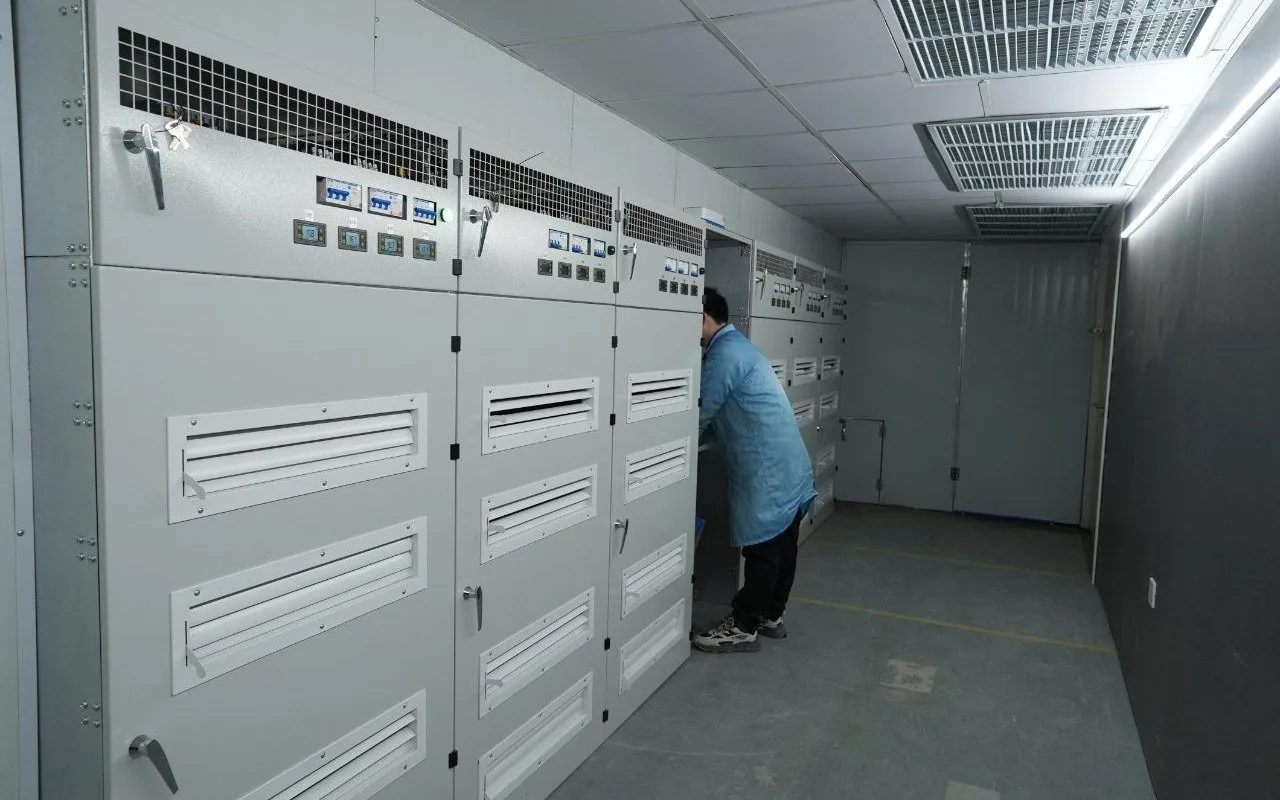
ISO-Accredited High Voltage Simulation Lab & Test Bay
Beyond Manufacturing: Complete System Integration
iKonMac operates dedicated high-voltage test bays and maintains experienced field engineering teams ready for worldwide deployment and remote diagnostic support. We manage the entire lifecycle so your substation or industrial plant achieves full harmonic mitigation and grid code compliance without operational friction.
High Voltage SVG Brochures, CAD Schematics & Whitepapers
Access verified sizing guides, CAD layouts, and technical papers for utility-scale SVG implementations.
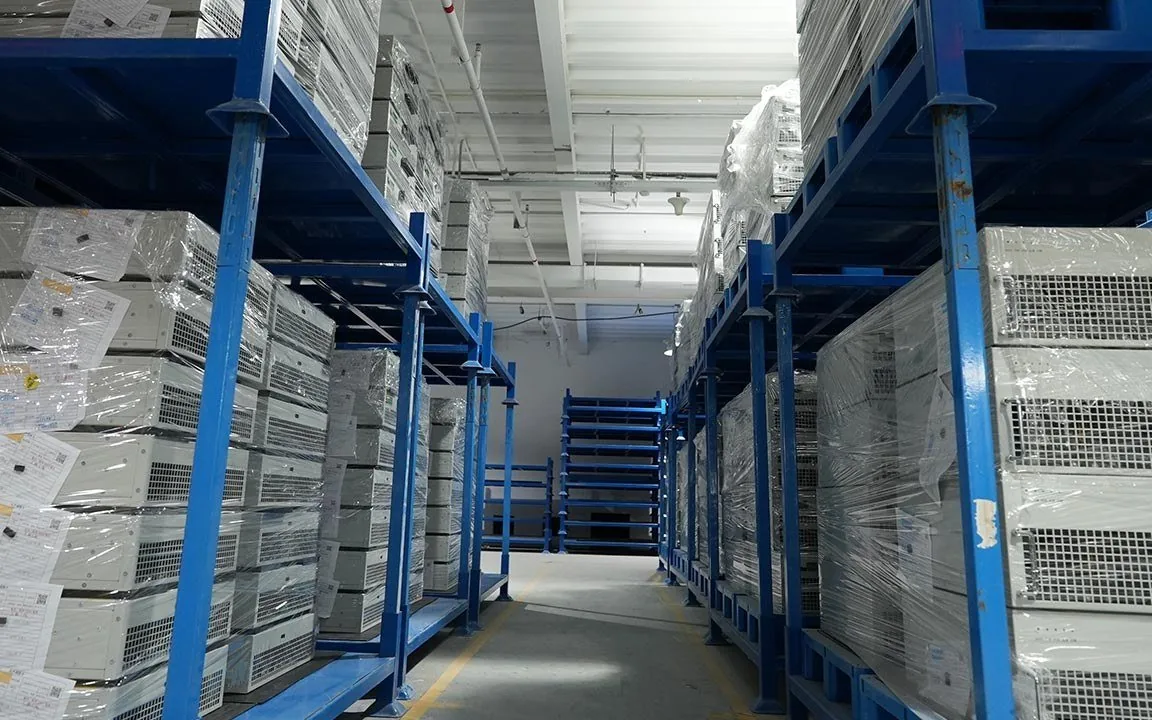
iKonMac 6kV–35kV High Voltage SVG Engineering Selection Guide
Complete static var compensator Mvar sizing tables, single-line schematics, terminal connection points, and electrical protection ratings.
- Comprehensive MV & HV nominal rating matrices
- Busbar sizing & transformer coordination curves
- Control cubicle terminal layout drawings
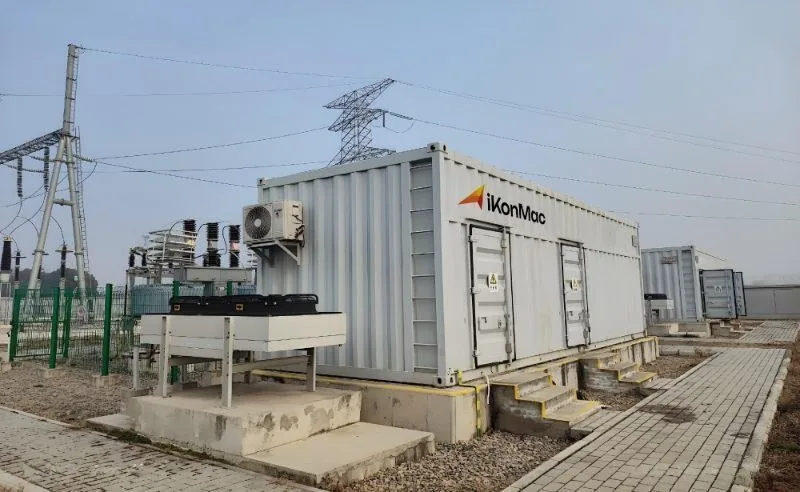
Outdoor Containerized SVG Civil Engineering & Interface Drawings
Foundation specifications, anchor bolt patterns, cable trench entries, and critical HVAC thermal clearances.
- Pre-cast concrete pad load distributions
- Bottom & side cable conduit ingress details
- Wind load & seismic tie-down calculations
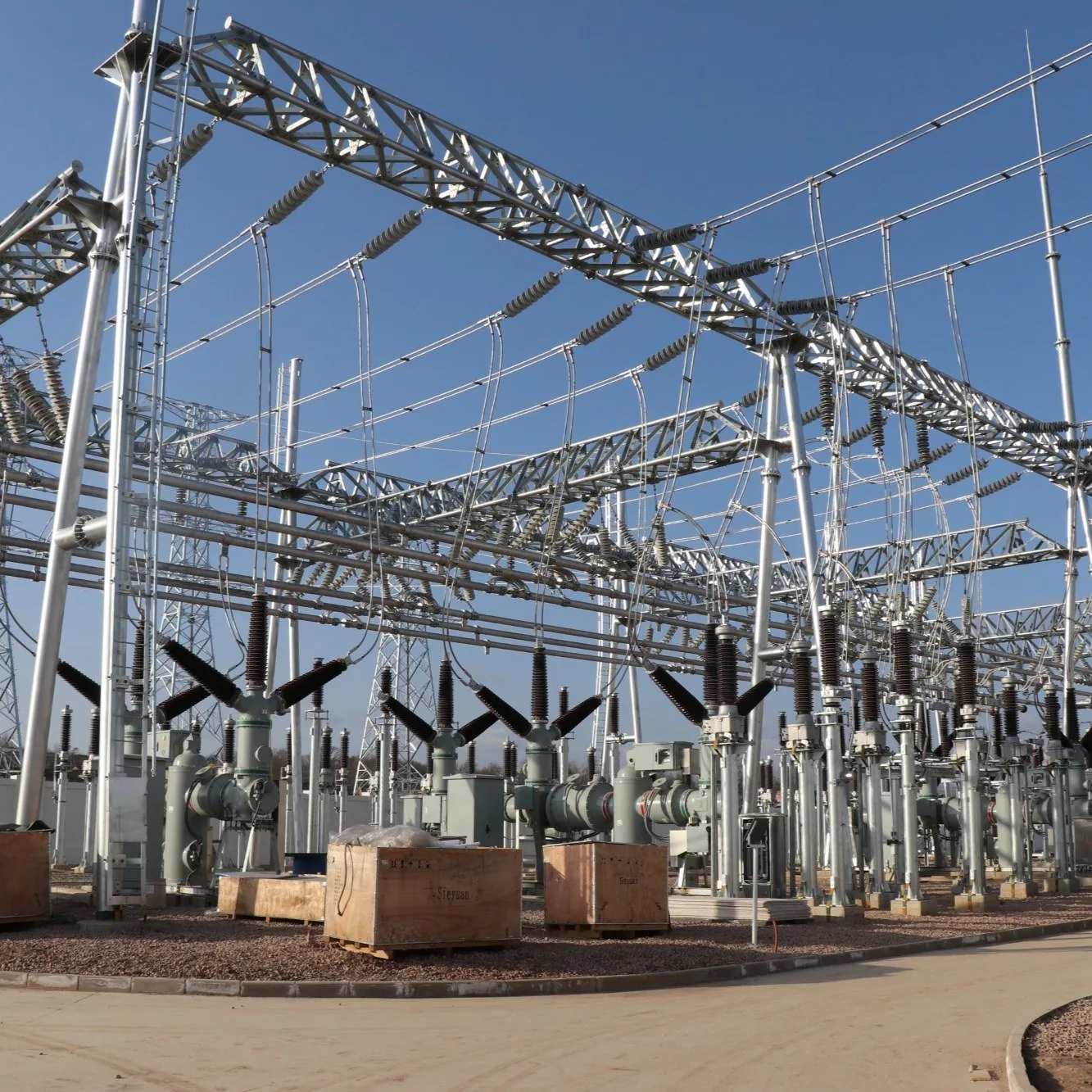
Dynamic Reactive Compensation in Renewable Grid Integration
Low-voltage ride-through grid-code compliance, sub-cycle voltage stabilization, and harmonic mitigation for resonance suppression.
- LVRT/HVRT response benchmark curves
- Solar PV & wind collector bus compensation
- Active power factor correction methodologies
Need Project-Specific Single-Line Diagrams or Custom Sizing?
Our application engineering group provides direct electrical transient simulations and tailored container arrangements for turnkey tenders.
High Voltage Static Var Generator Technical FAQ
Implementing high-voltage static var generators across utility distribution substations, large-scale renewables, and heavy industrial facilities demands precise reactive sizing, robust thermal architecture, and seamless SCADA automation. Modern 6kV, 10kV, and 35kV networks present distinct challenges from severe cyclic impact loads, fluctuating renewable dispatch, and strict utility interconnect requirements.
This technical guide addresses key architectural, operational, and maintenance inquiries for transmission planners, EPC electrical leads, and plant commissioning engineers evaluating multilevel cascaded H-bridge topologies and modular power quality equipment.
Sizing an industrial or utility high-voltage static var generator requires simultaneous evaluation of three electrical parameters: base displacement power factor objectives, step-up transformer series leakage reactance, and worst-case transient reactive swings.
Primary Mathematical Formulations for Sizing
- Steady-State Target Compensation: Q_target = P_max × (tan(φ_initial) - tan(φ_target)), where target displacement angle corresponds to cos φ ≥ 0.95 to 1.0 continuously.
- Transformer Reactance Consumption: Q_transformer = S_rated × (u_k% / 100), balancing internal leakage reactive drop across medium-voltage transformers during full export conditions.
- Dynamic Voltage Regulation Margin: Q_margin accounts for rapid sub-cycle load fluctuations from arc furnaces or gusts on wind plants, sized at 1.15× to 1.25× baseline demand.
For grid-tied wind and solar farms, system sizing must also satisfy regional Low Voltage Ride-Through (LVRT) and High Voltage Ride-Through (HVRT) standards. The SVG must supply 100% rated dynamic reactive current within 5ms during severe grid voltage dips down to near-zero residual voltage to prevent tripping.
Preventive Maintenance Schedule and Diagnostic Verification Matrix
Standard operational maintenance guide for engineering teams managing 6kV through 35kV dynamic reactive power compensation assets.
| Subsystem | Inspection Cadence | Diagnostic Checkpoint | Target Operational Value | Corrective Action |
|---|---|---|---|---|
| DC Bus Film Capacitors | Annual Outage | Capacitance measurement and ESR verification | ±5% of initial factory baseline | Power cell capacitor assembly replacement |
| Fiber Optic Trigger Bus | Bi-Annual | Optical signal power attenuation measurement | < 2.5 dB total optical channel loss | Connector ferrule cleaning or patch lead replacement |
| Cooling Air Filtration | Quarterly | Differential air pressure transducer monitoring | ΔP < 150 Pa across intake filter bank | Reusable filter screen vacuuming or media replacement |
| Power Cell Bypass Relays | Annual Outage | Mechanical and thyristor contact resistance check | < 50 micro-ohms contact resistance | Contact recalibration and thyristor trigger check |
| Coupling Reactor Assembly | Annual Outage | Infrared thermographic scan under rated current load | Winding temp rise < 80K above ambient | Ventilation duct inspection and terminal retorquing |
Need Grid Interconnection Simulation or Capacity Validation?
Our power systems engineering group executes digital twin simulations using DIgSILENT PowerFactory and MATLAB Simulink. Provide your single-line diagram (SLD), bus voltage, and Point of Common Coupling (PCC) short-circuit levels to receive an optimized SVG capacity calculation and footprint specification within 24 hours.
Consult with iKonMac Power Systems Engineers on Your High Voltage SVG Requirements
Submit your Single-Line Diagram (SLD), site power quality audit, or interconnection compliance targets. Our medium-voltage application engineers will deliver an optimized topology, civil footprint drawings, and an itemized commercial quotation within 24 hours.
Technical Parameter Specification
Define your point of common coupling parameters below for certified dynamic reactive power compensation sizing.
Engineering Heritage
Since 1994, Shanghai iKonMac Technology Co., Ltd. has delivered precision power electronics, field-proven reliability, and responsive engineering lifecycle support worldwide.
Immediate Technical Assistance
Consult directly with senior medium-voltage power electronic specialists for bus resonance mitigation, turnkey static var compensator integration, and IEEE 519 compliance verification.
Engineering Sales Channel
Tender specifications, SLD appraisal, and formal bidding support
Direct Telephone • WhatsApp Priority
Direct technical consultation with system application leads
Global R&D • Manufacturing Center
East Zone, 1st Floor, Building 1, No. 508 Chuanhong Road, Pudong New Area, Shanghai, China
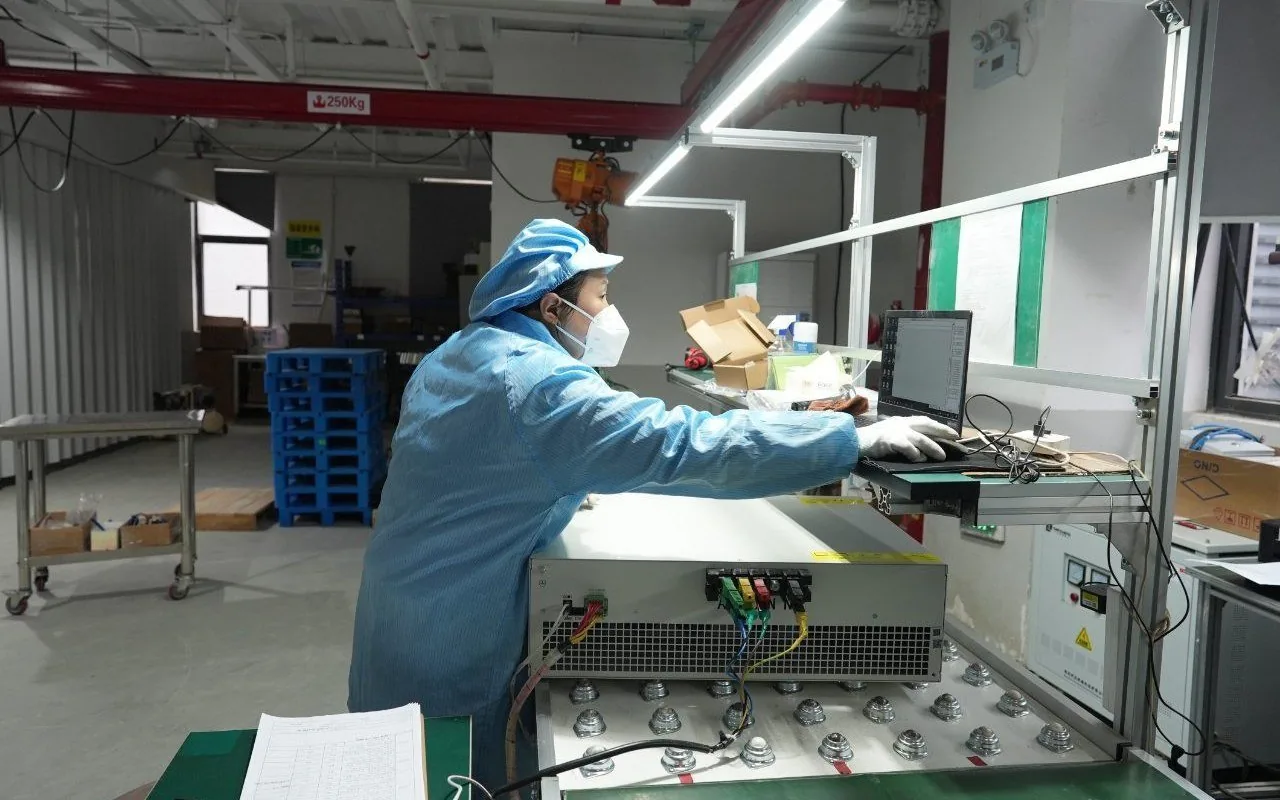
What Your 24-Hour Engineering RFQ Package Includes
- Full electrical topology coordinated with short-circuit MVA levels
- General arrangement dimensions, HVAC loads, and foundation guidelines
- Itemized manufacturing costs, standard FAT lead times, and Incoterms
- Grid code compliance validation against IEEE 519 and IEC 61000 benchmarks