
Industrial Harmonic Mitigation Solutions
Understanding Harmonics — Sources, THDi/THDv Dynamics, and Systemic Risks
Nonlinear electrical loads represent the principal origin of harmonic distortion across modern industrial and commercial power distribution networks. Front-end power conversion hardware—including variable frequency drives (VFDs), 6-pulse and 12-pulse rectifiers, DC drives, induction melting furnaces, central uninterruptible power supplies (UPS), and high-density switch-mode power supplies—draws current in abrupt, non-sinusoidal pulses. This switching behavior continuously injects high-order harmonic currents back into the plant electrical bus, corrupting upstream power quality and threatening infrastructure reliability.
Understanding how harmonic currents propagate through distribution architecture—and how they translate directly into harmful system voltage distortion—is critical for plant electrical engineers, reliability directors, and operations managers. Left unmanaged, severe harmonic pollution degrades baseline efficiency, creates safety hazards, causes non-compliance with strict utility interconnections, and subjects upstream distribution gear to destructive thermal and electrical stresses.
Core Harmonic Principles and Electrical Metrics
Total Harmonic Current Distortion (THDi)
THDi quantifies the ratio of total harmonic current components to the fundamental frequency current (50 Hz or 60 Hz). Industrial nonlinear loads operating without an active harmonic filter regularly exhibit THDi levels ranging from 30% to over 80%. When injected back toward the main switchgear, excessive THDi drives cable overheating, causes transformer core saturation, and serves as the primary root cause behind IEEE 519 grid interconnect compliance violations at the Point of Common Coupling (PCC).
Total Harmonic Voltage Distortion (THDv)
THDv represents cumulative voltage waveform deviation resulting from harmonic currents traversing source impedances, such as substation transformers, line reactors, and distribution cabling ($V_h = I_h times Z_h$). When heavy harmonic currents interact with high system impedance, supply voltage waveforms become severely flat-topped and notched. Industry compliance codes restrict THDv to under 5% (and under 3% for sensitive buses) to safeguard downstream equipment.
The Conduction Relationship: Harmonic currents originate at the terminal loads and travel upstream toward the lowest electrical impedance. As this distorted current passes through upstream transformers and utility service lines, the resultant harmonic voltage drop contaminates the common distribution bus. Consequently, unmitigated THDi generated inside one manufacturing cell propagates outward as elevated THDv, degrading power quality for sensitive branch circuits and neighboring facilities sharing the utility feeder.
Accelerated Transformer Derating and Cable Thermal Stress
High-frequency harmonic currents induce severe parasitic eddy current losses in transformer windings and core laminations, alongside pronounced skin-effect losses within busbars and power feeder cables. Because eddy current heating increases with the square of the harmonic frequency ($P_{ec} propto f^2$), elevated 5th, 7th, 11th, and 13th harmonics generate intense, concentrated thermal overloads.
This chronic thermal strain drives rapid dielectric insulation breakdown, severely degrading the transformer's operating K-Factor margin and forcing asset derating by 20% to 40% to avoid thermal runaway. Facilities face premature transformer failures, shortened asset lifespans, and substantial capital expenditures for early replacements.
Power Factor Capacitor Resonance and Catastrophic Burnout
Standard un-detuned power factor correction (PFC) capacitor banks naturally form parallel and series resonant circuits with upstream service transformers. When characteristic harmonic frequencies from variable frequency drives match the natural resonant frequency of the capacitor network, circulating harmonic currents become dramatically amplified.
This destructive resonance condition creates extreme transient overvoltages and overcurrent spikes, causing severe capacitor cell swelling, dielectric puncture, internal fuse operations, and catastrophic casing explosions. The loss of stable reactive power compensation triggers heavy utility low-power-factor penalties alongside extensive safety and downtime risks.
Precision Control Equipment Lockouts and Automation Errors
Programmable logic controllers (PLCs), computer numerical control (CNC) machining centers, robotic welding units, and semiconductor lithography platforms rely on clean voltage sinusoidal zero-crossings for accurate internal timing and SCR phase-angle firing. Severe THDv introduces multiple zero-crossing notches and phase angle displacement.
These waveform deformities cause microsecond controller resets, synchronization failures, encoder signal corruption, and sudden machine lockouts. In automated manufacturing, semiconductor fabrication, and pharmaceutical processing, an unexpected harmonic-induced interruption can ruin high-value production batches within seconds.
Neutral Conductor Overheating and Protection Nuisance Tripping
Triplen harmonics (predominantly 3rd, 9th, and 15th orders) do not cancel out in three-phase four-wire distribution circuits; instead, they add arithmetically in the neutral conductor. This additive current can cause neutral bus loading to reach 130% to 180% of phase current, creating extreme fire hazards and severe thermal damage along ungrounded runs.
At the same time, high peak harmonic crest factors distort the true RMS sensing circuitry of electronic protective relays and thermal-magnetic breakers. This distortion triggers intermittent, uncoordinated false tripping, shutting down main feeders without warning, disrupting continuous processes, and complicating post-fault diagnostics.
Engineered Mitigation: Eliminating Systemic Vulnerabilities at the Source
Harmonic distortion in modern industrial infrastructure is not merely an efficiency concern—it is a critical point of systemic failure that threatens operational continuity, damages capital electrical assets, and incurs harsh utility non-compliance fines. Passive fixes often introduce dangerous LC resonance, whereas an advanced ultra active harmonic filter dynamically cancels harmonic pollution across dynamic load changes. Drawing on 30 years of industrial power quality diagnostic experience, the iKonMac engineering team performs comprehensive on-site spectrum evaluations across complex nonlinear load profiles, sizing robust Active Harmonic Filter (AHF) solutions that secure verified IEEE 519 compliance and restore electrical system reliability.
Grid Compliance & Standards — IEEE 519 and IEC Standards
Modern electric utilities enforce strict power quality thresholds at the Point of Common Coupling (PCC) to protect shared distribution infrastructure. The proliferation of non-linear equipment—including variable frequency drives, DC rectifiers, and high-capacity UPS topologies—injects significant harmonic currents back into the utility feeder. Left unmitigated, these distortions degrade line voltage stability, skew digital revenue metering, and trigger costly utility surcharges or service disconnection. Installing an active harmonic filter alongside conforming to IEEE 519 and IEC 61000 grid codes protects capital assets while maintaining uninterrupted operational licensing.
IEEE 519 Current Distortion Limits at the Point of Common Coupling
The IEEE 519-2022 standard sets clear harmonic voltage and current limits at the Point of Common Coupling (PCC). Rather than measuring individual branch circuits, the standard evaluates the utility-customer interface. Current distortion limits are structured around the facility’s Short-Circuit Ratio (ISC/IL), which compares available utility fault current to the facility's maximum fundamental load demand.
Facilities tied to weaker grids or low fault ratios face stricter Total Demand Distortion (TDD) limits. Permissible current limits range from 5.0% TDD on high-impedance utility ties up to 20.0% TDD on stiff distribution buses. Additionally, bus voltage distortion must remain strictly below 5.0% THDv on low-voltage services (≤ 1 kV), with no single harmonic order exceeding 3.0% to prevent system-wide parallel resonance.
- PCC Voltage Control: Enforces bus voltage distortion below 5.0% THDv.
- Graded TDD Limits: Restricts current injection to 5.0%–20.0% based on short-circuit stiffness.
- Even Harmonic Limits: Caps even harmonics at 25% of odd harmonic allowances.
- Statistical Verification: Requires compliance across 95th and 99th percentile weekly recordings.
IEC 61000 Voltage Compatibility and Emission Allocation
International networks outside North America follow the International Electrotechnical Commission framework. IEC 61000-2-4 defines electromagnetic compatibility levels for low-frequency conducted disturbances across industrial distribution networks, grouping facilities into three distinct operational classes based on harmonic density and asset sensitivity.
Engineered for cleanrooms, automated testing centers, and mission-critical server halls.
Standard utility Point of Common Coupling for general commercial, logistics, and manufacturing plants.
Heavy industrial internal distribution feeds powering arc furnaces, rolling mills, and large drives.
Complementing these requirements, IEC 61000-3-6 outlines technical criteria for allocating harmonic emission limits to high-capacity industrial plants connected to medium-voltage (MV) and high-voltage (HV) grids. Integrating a high-voltage SVG with proper emission planning prevents cumulative harmonic propagation from compromising regional substation transformers.
Utility Tariff Penalties and Revenue Meter Distortions
Harmonic distortion directly inflates monthly electrical billing. Modern solid-state electronic meters capture true power factor (PFtrue), which accounts for harmonic distortion power (kvarh) alongside displacement power factor (PFdisp). Because non-linear currents inflate apparent power (kVA) without delivering useful mechanical work (kW), facilities face recurring low-power-factor penalties even when using fixed capacitor banks.
Utility providers continuously monitor power quality at industrial substations. Facilities that exceed PCC distortion thresholds risk formal non-compliance notices, financial surcharges, or forced disconnection if harmonic backfeed interferes with neighboring industrial consumers.
Proven Global Track Record: iKonMac power quality solutions have helped industrial enterprises across more than 50 countries and regions achieve full compliance with IEEE 519 and international grid interconnection codes.
IEEE 519 Current Distortion Limits at PCC
Standard 519-2022| Isc / IL Ratio | h < 11 | 11 ≤ h < 17 | Max TDD |
|---|---|---|---|
| < 20 | 4.0% | 2.0% | 5.0% |
| 20 < 50 | 7.0% | 3.5% | 8.0% |
| 50 < 100 | 10.0% | 4.5% | 12.0% |
| 100 < 1000 | 12.0% | 5.5% | 15.0% |
| 1000 | 15.0% | 7.0% | 20.0% |
Note: Harmonic orders are expressed as percentages of rated maximum demand load current. Even harmonics are limited to 25% of odd harmonic limits.
Measurable Value of Grid Interconnection Compliance
Eliminating excessive harmonics at utility substations resolves regulatory liabilities while delivering direct operational and financial improvements.
Eliminates power factor billing penalties on monthly utility power invoices.
Reclaims substation transformer headroom by eliminating harmonic eddy-current derating.
Prevents thermal degradation across power cables, switchgear contacts, and motors.
Eliminates zero-crossing waveform anomalies that cause protective relay nuisance trips.
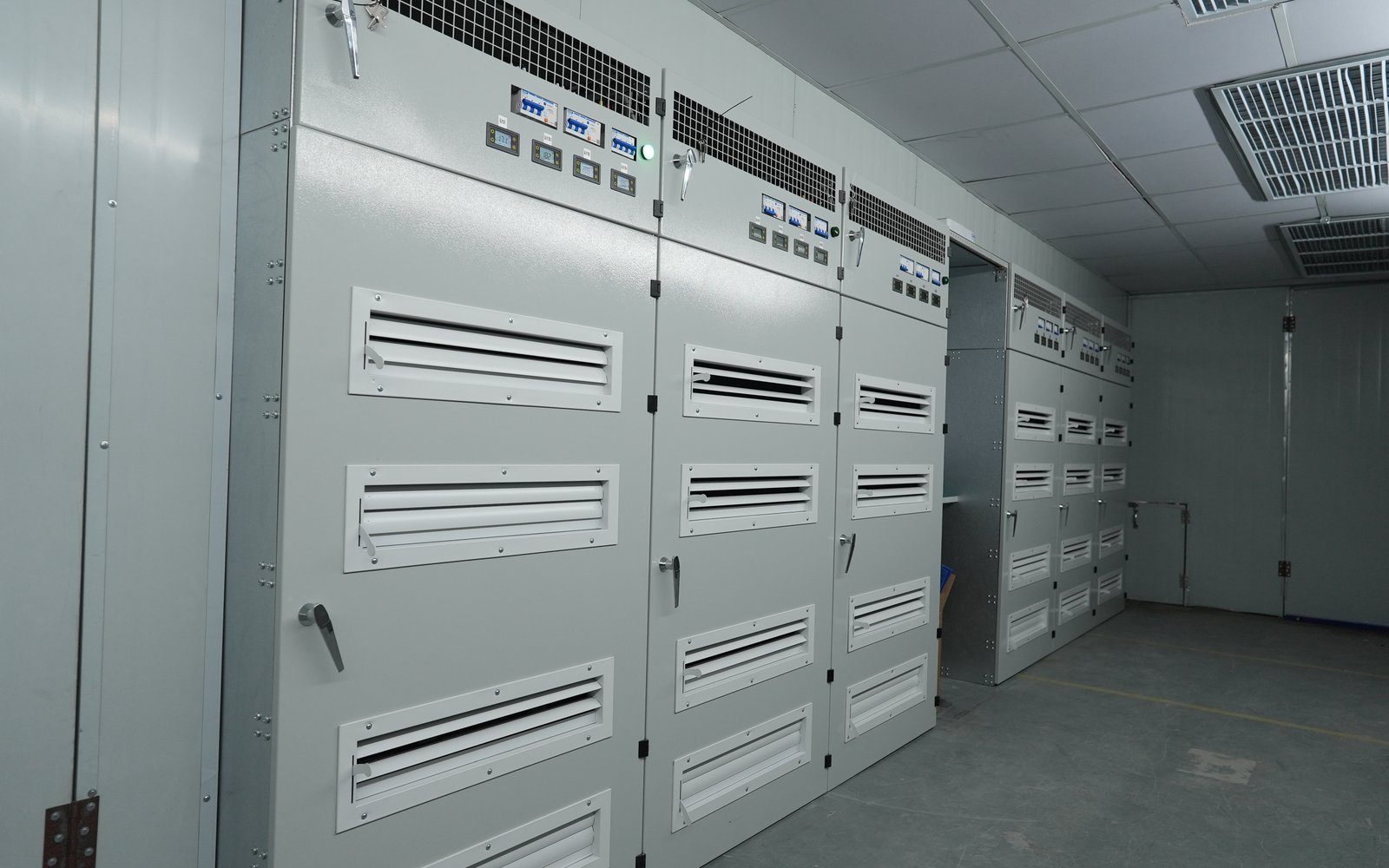
Standard centralized harmonic mitigation configuration positioned at the primary switchgear Point of Common Coupling, maintaining continuous dynamic wave cancellation across fluctuating load profiles.
iKonMac Active Filtering Hardware & Solutions Portfolio
Modern industrial plants, data centers, and commercial facilities rely heavily on variable frequency drives (VFDs), thyristor rectifiers, induction furnaces, and high-frequency power supplies. These nonlinear loads inject severe harmonic currents back into the power distribution network, generating destructive thermal stress on upstream transformers, overloading neutral conductors, triggering false protection trips, and causing non-compliance penalties under IEEE 519 and IEC 61000 standards.
Backed by three decades of power electronics engineering and field diagnostic expertise, iKonMac produces over 3.5 million Amperes and kvar in annual equipment capacity. Supported by an R&D team of more than 50 dedicated power quality specialists, our comprehensive lineup of power quality products spans standard industrial manufacturing, heavy transient processing, and ultra-high-efficiency semiconductor fabrication environments.
Active Harmonic Filter (AHF)
Three-Level Inverter Dynamic Filtering
Engineered for mainstream manufacturing plants, municipal utilities, and commercial facilities, the iKonMac Active Harmonic Filter (AHF) utilizes a three-level neutral point clamped (NPC) inverter topology to dynamically neutralize low- and mid-spectrum harmonic distortion. The unit continuously samples bus current in real time, injecting instantaneous anti-phase compensation currents to maintain clean sinusoidal waveforms.
Core Capabilities
- · Harmonic Spectrum: Dynamic, simultaneous mitigation across 2nd to 50th harmonic orders with individual harmonic order selection
- · Integrated Compensation: Concurrent active harmonic cancellation, stepless reactive power correction, and three-phase unbalance balancing
- · Topology Advantage: Three-level NPC architecture lowering device switching stress, cutting internal losses, and optimizing output ripple
Target Applications
Commercial buildings, water and wastewater treatment facilities, HVAC central chiller plants, light assembly lines, conveyor systems, and logistics distribution hubs.
Ultra Active Harmonic Filter
High-Frequency DSP + FPGA Dual-Core Control
Built specifically for heavy industrial environments characterized by rapid step loads, high-order harmonic interferences, and severe voltage fluctuations. The Ultra Active Harmonic Filter leverages synchronized DSP and FPGA co-processors to compute vector compensation in microseconds, suppressing rapid transient surges and severe harmonic resonance before distortion reaches the utility point of common coupling.
Core Capabilities
- · Transient Response: Total dynamic response speed under 5 milliseconds for instantaneous surge suppression and stabilization
- · Dual-Core Control: Parallel DSP plus FPGA real-time calculation engine executing complex high-order spectral algorithms
- · Overload Protection: Automatic current-limiting capability ensuring continuous harmonic filtering without nuisance thermal shutdowns
Target Applications
Steel manufacturing, induction melting, automotive robotic weld lines, electric arc furnaces (EAF), heavy mining hoists, and metal extrusion rolling mills.
Silicon Carbide (SiC) Solutions
3rd Generation SiC Power Semiconductor Architecture
Representing the leading edge of modern power electronics, iKonMac Silicon Carbide active power quality platforms replace traditional silicon IGBT modules with third-generation SiC MOSFETs. Higher switching frequencies drastically reduce system thermal dissipation, significantly increase power density, and deliver near-inaudible operation in noise-sensitive critical facilities.
Core Capabilities
- · High Efficiency: System thermal dissipation and switching losses cut by over 40% compared to conventional silicon IGBT filters
- · High Power Density: Compact footprint optimized for high-density electrical rooms, modular skids, and containerized substations
- · Switching Bandwidth: High carrier frequency for precise suppression of higher-order harmonics without acoustic resonance
Target Applications
Semiconductor fabrication cleanrooms, hyperscale cloud data centers, precision pharmaceutical compounding, research laboratories, and critical medical infrastructure.
Modular Parallel Expansion Architecture
iKonMac active harmonic filters are engineered around a standardized, field-proven modular design. Instead of relying on rigid, single-point-of-failure monolithic enclosures, our systems utilize hot-swappable sub-rack modules rated across 50A, 100A, and 150A capacities. Multiple modules can be paralleled over an isolated high-speed communication bus with deterministic phase synchronization.
The integrated master-slave management controller dynamically balances compensation demands across all online modules. If a single module is bypassed for preventive maintenance, remaining units instantly redistribute the filtering output across the bus within microseconds, maintaining continuous power quality protection and complete IEEE 519 compliance without facility downtime.
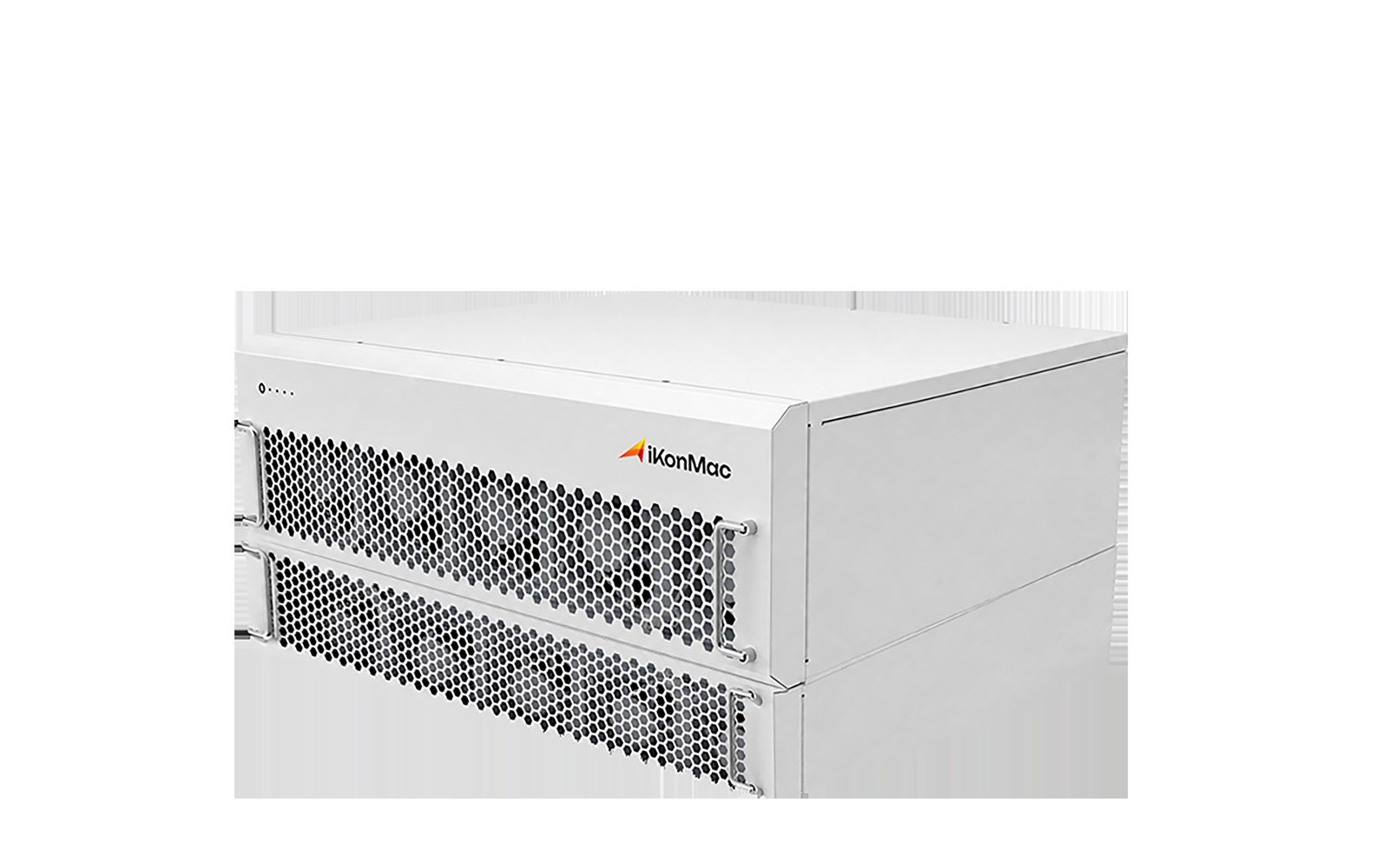
Engineering Hardware Specification Matrix
Compare key electrical, control, and operational parameters across the iKonMac active harmonic filter hardware series.
| Engineering Parameter | Active Harmonic Filter (AHF) | Ultra Active Harmonic Filter | Silicon Carbide (SiC) Platform |
|---|---|---|---|
| Power Inverter Topology | Three-Level NPC Topology | High-Speed Three-Level NPC Topology | Third-Generation SiC MOSFET Bridge |
| Harmonic Mitigation Range | 2nd to 50th Order Simultaneous | 2nd to 50th Order (Transient Optimized) | 2nd to 50th Order Extended Bandwidth |
| Target Post-Mitigation THDi | < 5% at rated operating capacity | < 3% under dynamic transient loading | < 2.5% ultra-clean baseline profile |
| Total Dynamic Response Time | < 10 milliseconds | < 5 milliseconds | < 5 milliseconds instantaneous |
| Control Processing Architecture | High-Speed 32-Bit Floating-Point DSP | Dual-Core 32-Bit DSP + FPGA Array | High-Frequency Wide-Bandgap Digital Core |
| Internal Operating Losses | < 3.0% of rated operating capacity | < 2.8% of rated operating capacity | < 1.8% (> 40% lower thermal loss) |
| Form Factor & Mounting | Wall-Mounted / 19-inch Sub-Rack Module | Heavy-Duty Modular Floor-Standing Cubicle | Ultra-High-Density Rack / Wall Enclosure |
| Industrial Communication Protocols | Modbus RTU (RS485), Modbus TCP/IP | Modbus TCP/IP, Profibus-DP, EtherNet/IP | Modbus TCP/IP, BACnet/IP, RESTful API |
Active Harmonic Filters vs. Passive Harmonic Filters
Compare essential mitigation metrics to choose the right architecture for modern industrial power distribution systems.
2nd to 50th Harmonics
Active filters dynamically cancel multiple harmonic frequencies at once with continuous load tracking.
Zero Resonance Risk
Intelligent active impedance reshaping prevents catastrophic parallel resonance across all grid topologies.
< 5 ms Dynamic Response
Digital signal processing instantly injects precise counter-phase currents during abrupt variable frequency drive changes.
Engineering Specification Matrix
Side-by-side technical performance comparison across critical power quality parameters.
| Evaluation Criterion | Traditional Passive Filter (LC) | iKonMac Active Harmonic Filter (AHF) Advanced |
|---|---|---|
| Mitigation Spectrum Harmonic order range | ✕ Fixed Single-Order Only Addresses only pre-tuned discrete frequencies (e.g., 5th or 7th order). Requires parallel banks for additional orders. | ✓ 2nd to 50th Harmonics Dynamically Monitors entire spectrum simultaneously. Injects precise anti-phase currents for comprehensive clean power. |
| Response Speed & Dynamics Reaction to load swings | △ Steady-State Dependent Relies on passive LC tank circuits. Incapable of reacting to high-speed dynamic load variations. | ✓ Real-Time DSP Sensing (< 5 ms) High-frequency digital sampling enables instantaneous mitigation during fast load steps. |
| Resonance Vulnerability System harmonic stability | ✕ High Resonance Risk LC parameters easily interact with utility transformer impedance, causing hazardous parallel resonance and component failure. | ✓ Intrinsically Immune Intelligent active impedance reshaping prevents resonance interactions regardless of grid source impedance changes. |
| Load Adaptability Light-load performance | ✕ Frequent Over-Compensation Provides fixed leading reactive power. Causes dangerous bus voltage rise and leading power factors during off-peak loads. | ✓ Closed-Loop Dynamic Tracking Injects only exact required compensation current. Helps avoid voltage elevation and leading power factor penalties. |
| Overload Protection Thermal and fault limits | ✕ Susceptible to Thermal Overload Excessive background harmonics cause severe inductor overheating, blown fuses, or ruined capacitor cells. | ✓ Automatic Electronic Current Limiting Maintains full rated output continuously without tripping. Automatically caps compensation safely at 100% capacity. |
| Footprint & Scalability Space and expansion | ✕ Bulky, Fixed Iron-Core Footprint Heavy floor-mounted cabinets. System expansion demands costly complete unit replacements or civil engineering work. | ✓ Modular Hot-Swappable Density Available in compact wall-mount or standard 19-inch rack enclosures. Up to 65% floor space savings. |
Eliminating Systemic Grid Resonance with Adaptive Algorithms
The iKonMac active harmonic filter utilizes intelligent adaptive control algorithms that fundamentally eliminate the parallel resonance hazards inherent to traditional passive capacitor setups.
While passive filters lock facilities into rigid impedance traps, active filtering synthesizes real-time counter-frequencies via insulated-gate bipolar transistor (IGBT) switches while delivering dynamic reactive power compensation. The result is uncompromised compliance with IEEE 519 standards and guaranteed downstream protection for sensitive automation hardware.
Automatic multi-order harmonic suppression
Built-in reactive power & unbalance compensation
Plug-and-play modular power expansion
Zero harmonic resonance risk on generator supplies
Engineering Process — From Field Harmonic Audit to Verified Results
iKonMac executes a structured, closed-loop engineering delivery path engineered to eliminate integration risks and de-risk capital expenditures. From baseline harmonic analysis to post-energization verification, our dedicated power quality teams support measurable grid compliance with IEEE 519 and IEC 61000 standards.
Phase 01
Site Audit & Harmonic Spectrum Testing
We deploy Class A power quality analyzers directly at the Point of Common Coupling (PCC) and critical distribution buses to continuously log voltage waveforms, dynamic current profiles, background THDv, load-generated THDi, and discrete spectrum orders up to the 50th harmonic across all operational shifts.
Phase 02
Sizing & Topology Engineering
Leveraging empirical audit logs, our power systems engineers calculate exact harmonic compensation currents, analyze short-circuit ratios (Isc/IL), and evaluate parallel resonance risks to determine optimal deployment architecture—whether centralized bus correction, decentralized group filtering, or localized point-of-load treatment.
Phase 03
Deployment & Commissioning
Our certified field engineers oversee mechanical mounting, external CT orientation checks, and thermal clearances for modular active harmonic filter units. We configure multi-module master-slave digital communications, tailor harmonic cancellation priorities, and calibrate sub-cycle dynamic response without production downtime.
Phase 04
Validation & Performance Reporting
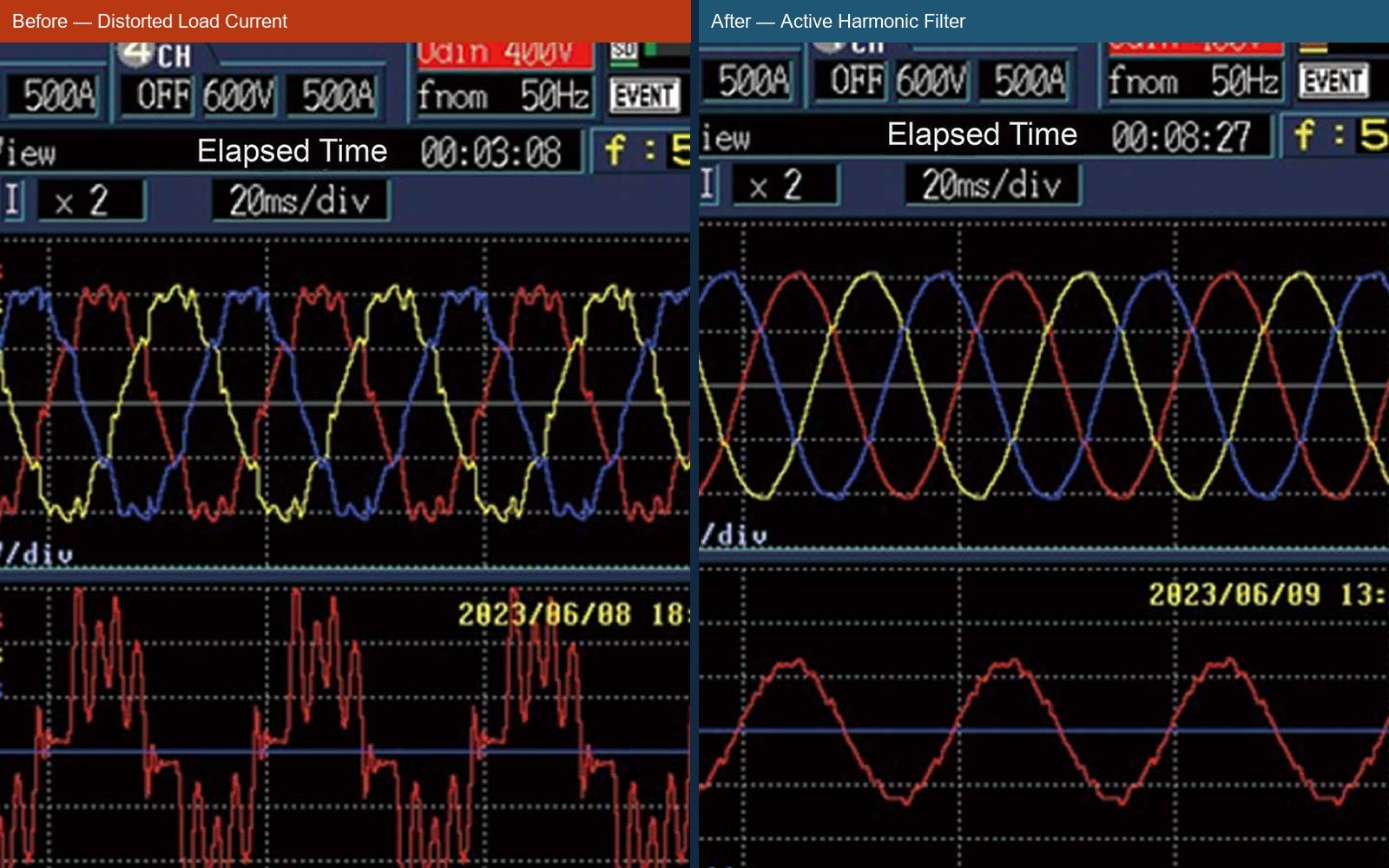
We conduct post-commissioning verification by recording closed-loop electrical waveforms under peak industrial load conditions. Clients receive a comprehensive engineering report documenting THDi suppression below target thresholds (typically <3%–5%), system loss reductions, and certified compliance with utility interconnection standards.
Accelerate Your Facility's Path to Grid Compliance
iKonMac delivers complete turnkey engineering solutions encompassing baseline diagnostic audits, precision hardware manufacturing, on-site commissioning, and comprehensive operational training. Partner with our senior technical specialists to eliminate non-linear distortion, protect sensitive plant equipment, and support absolute compliance with regional grid codes.
Industry Applications & Proven Harmonic Mitigation Results
Nonlinear load profiles introduce severe electrical stresses tailored to specific operating conditions. iKonMac engineers dynamic active harmonic filter systems designed to eliminate high-order current distortion, restore sinusoidal bus voltage, and protect critical downstream capital assets. Review empirical before-and-after operational data across four high-demand sectors where active power quality remediation safeguards operational continuity and supports IEEE 519 grid compliance.
Semiconductor & Precision Electronics
Extreme sensitivity to voltage flat-topping in photolithography tools, ion implanters, and automated wafer handlers. Front-end 6-pulse and 12-pulse rectifiers produce severe 5th, 7th, 11th, and 13th harmonic currents that distort common bus waveforms and trigger unexpected automated line lockouts.
Operational Impact
- Zero unplanned downtime across precision robotic cleanroom cells.
- Eliminated thermal derating on upstream dry-type distribution transformers.
Hyperscale & Enterprise Data Centers
High densities of single-phase switch-mode power supplies (SMPS) generate severe 3rd-order zero-sequence triplen harmonics. These currents accumulate directly onto neutral conductors, causing dangerous neutral-to-ground voltages, transformer overheating, and elevated PUE overhead.
Operational Impact
- Measurable PUE efficiency gains by eliminating harmonic core losses.
- Mitigated neutral conductor fire hazards without costly double-neutral cabling.
Heavy Industry & Steel Processing
Multi-megawatt variable-frequency motor drives, hot-strip rolling mills, and electric induction furnaces inject violent dynamic harmonic swings into the substation bus. High harmonic currents overheat traditional capacitor banks—demanding dynamic static var compensator technology—and breach PCC utility compliance thresholds.
Operational Impact
- Complete elimination of recurring utility harmonic non-compliance surcharges.
- Restored substation transformer capacity headroom for future production expansion.
Hospitals & Healthcare Facilities
High-field MRI scanners, multi-slice CT systems, and linear accelerators draw rapid pulsed currents that degrade local voltage wave shapes. Unchecked harmonic distortion induces diagnostic image artifacts, corrupts bio-telemetry networks, and destabilizes emergency generator switchgear.
Operational Impact
- Preserved diagnostic scan fidelity and patient telemetry communication.
- Guaranteed stable synchronization during emergency backup generator transition testing.
Global Field Reliability Across Demanding Industrial Environments
Over 3,000 industrial facilities, hyperscale data centers, and critical healthcare campuses rely on iKonMac power quality products worldwide. Our active filtration platforms eliminate electrical resonance risks, protect sensitive processing assets, and deliver verifiable compliance with IEEE 519 and IEC 61000 grid interconnect standards.
Frequently Asked Questions on Harmonic Mitigation
Technical analysis and system design guidance for electrical engineers, facility directors, and consulting specifiers. Review rigorous capacity sizing formulas, hybrid reactive power coordination, IEEE 519-2022 grid compliance thresholds, and next-generation Silicon Carbide active filter architectures.
Need On-Site Harmonic Logging or System Sizing Assistance?
iKonMac senior application engineers provide complete IEEE 519 compliance modeling, harmonic spectrum assessment, and modular active filter selection for demanding industrial grids worldwide.